


Page 832 - Furniture Cabinetry Hardware-FloorKitchenResource.com
P. 832
Hinges and Stays
            Concealed Hinges


             Salice


             → Opening Angle – What are your options?           → Closing Method – What are your options?
            94°                                                Self-Closing
             >  Often used on an end panel against a wall or another cabinet   >  The standard hinge for the industry, the spring in the hinge arm
                 to restrict the opening                          holds the door shut
             >  For increased reduction of opening angle
             >  Many pocket door systems use this hinge        Free-Swinging
             >  Commonly used for thick door applications with narrow stiles
             >  Use where appliances or where cabinet depths limit opening  >  Does not have an internal spring
               angle                                            >  Typically used with touch latches – partial opening
             >  Angle reduction clips reduce angle further to 86°
                                                               Silentia+
            94° Thick Door                                      >  This type of hinge will keep the door from slamming and provide
             >  For thick doors with narrow stiles                a nice soft closing action
             >  Less concern of drilling through coping detail  >  It is important to note that this type of hinge requires a deeper
             >  Possible tab distance 3–9 mm (1/4"–11/32") on square edged     than normal hole in the door, precise drilling depth for optimal
               door; larger tabs on door with front edge detail    performance
             >  Doors up to 35 mm (1 1/4") thick
             >  Overlays up to 24 mm (15/16")                  PUSH
                                                                >  This type of hinge combined with the proper latch, will allow
            105°                                                  the door to open automatically when it is pressed
                                                                >  The spring is reversed to push the door completely open,
             >  Shallow 8 mm (5/16") deep cup
             >  Used for unusually thin door applications 10 mm (3/8")    rather than hold it shut
             >  Non-dowelled                                    >  It must always be used in combination with a PUSH latch
             >  Gap between door: .2 mm on a 10 mm (3/8") door  >  Touch latch
                            2.3 mm on a 19 mm (3/4") door
                                                                → Mounting Method - What are your options?
            110°
             >  The standard opening angle for a concealed hinge and is the    Screw
               most commonly used
                                                                >  Drill a 35 mm (1 3/8") hole in the door and attach hinge with
            120°                                                    (2) #6 wood screws
             >  Often used in kitchen applications, it allows for greater access    Dowel
               into the cabinet
             >  Commercial specs                                >  Drill a 35 mm (1 3/8") hole and and (2) 8 mm (5/16") holes,
                                                                  this is the most common application in the industry
            155°                                                >  The hinge would then be pressed into the door using a hinge
                                                                  machine or rubber mallet
             >  Zero protrusion on full overlay (0, 2 mm mounting plates)  >  The dowels are not removable once they are inserted
             >  Commonly used with pull-out/roll-out shelves    >  The hinge can only be removed by backing the screws out
     9       >  Available in thin and thick door applications     of the dowels
             >  Available in Silentia+
                                                               Rapido
            165°
                                                                >  Drill a 35 mm (1 3/8") hole and and (2) 8 mm (5/16") holes
             >  Allows for the most access into the cabinet     >  The hinge is attached by turning 2 locking dowels 1/2 turn (180º)
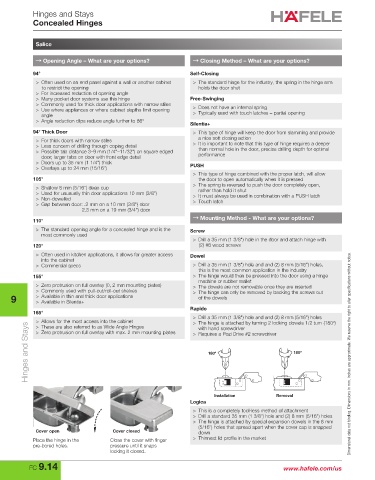
          Hinges and Stays                                           180º                        180º              Dimensional data not binding. Dimensions in mm, inches are approximate. We reserve the right to alter specifications without notice.
             >  These are also referred to as Wide Angle Hinges
                                                                  with hand screwdriver
             >  Zero protrusion on full overlay with max. 2 mm mounting plates
                                                                >  Requires a Pozi Drive #2 screwdriver


                                                                       Installation        Removal
                                                               Logica
                                                                >  This is a completely tool-less method of attachment
                                                                >  Drill a standard 35 mm (1 3/8") hole and (2) 8 mm (5/16") holes
                                                                >  The hinge is attached by special expansion dowels in the 8 mm
                                                                  (5/16") holes that spread apart when the cover cap is snapped
             Cover open               Cover closed                down
            Place the hinge in the   Close the cover with finger  >  Thinnest lid profile in the market
            pre-bored holes.         pressure until it snaps
                                     locking it closed.

           FC 9.14                                                                            www.hafele.com/us

